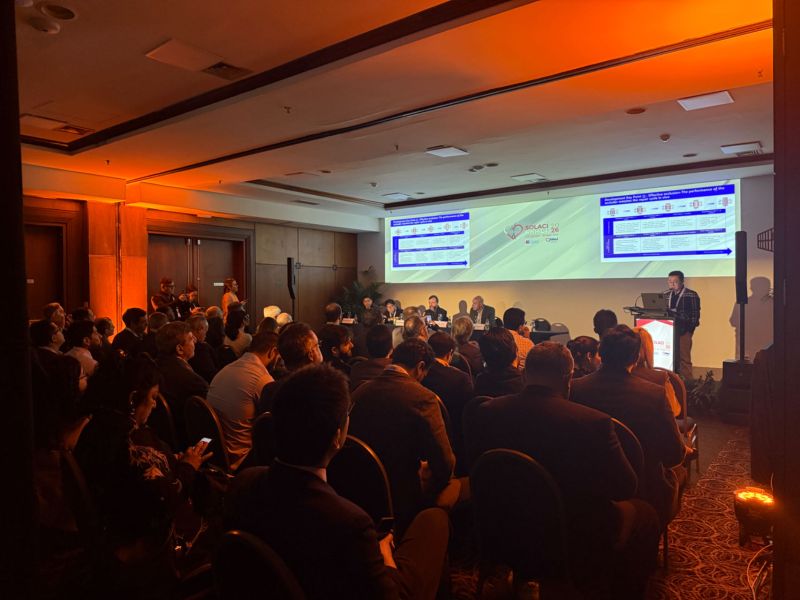


Biodegradable ASD/PFO Closure: Clinical Evidence and Case Series – Reviewed at SOLACI 2026
-
 2026-08-27
-
LEPU Medical


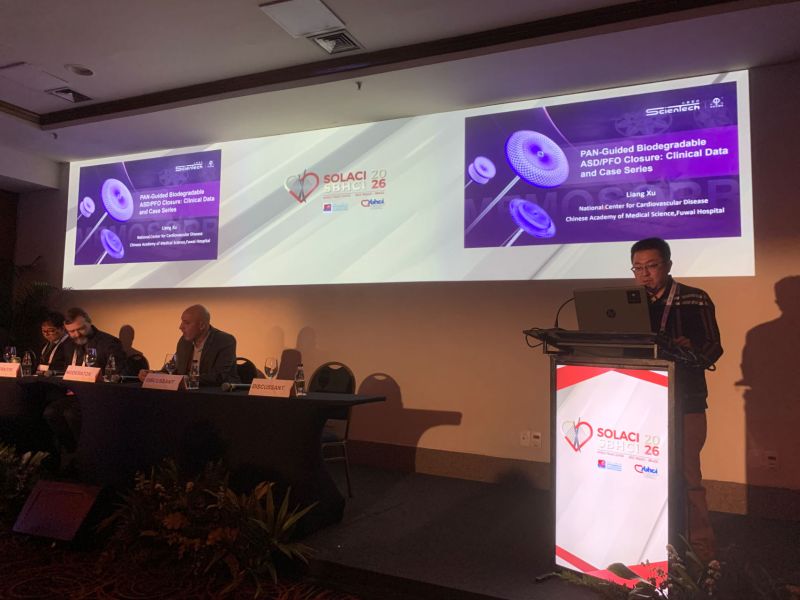
We are pleased to share the data and cases reviewed by Dr. Liang Xu (Fuwai Hospital) at the SOLACI 2026 & SBHCI 2026 Joint Meeting. These materials, from published multicentre trials, support a biodegradable occluder that fully degrades in 12–24 months, leaving no permanent implant – a significant advance in CHD interventions.
Product Highlights
Our MemoSorb® occluder (ASD/PFO/VSD) is made of biomedical polymers with a controlled degradation cycle matching tissue repair. Its patented parachute‑shaped locking and double‑disc inner‑buckling design ensure stable clamping and promote rapid endothelialisation. The delivery system includes a moulding wire (withdrawn intraoperatively) and 4 platinum markers (PFO Occluder) for DSA visibility, with ultrasound providing full procedural guidance.
Clinical Data (vs. Metal Occluder)
Primary efficacy: occlusion success rate met non‑inferiority (95% CI lower bound > –10%).
Residual shunt: no significant difference at 6 or 12 months (Grade 0: 61.5% vs. 68.1% at 6 months).
Migraine relief: overall disappearance rate 82.5% (test 85.9% vs. control 78.8%).
Arrhythmia: at 12 months, test group 15.6% vs. control 21.8%; no AV block or atrial premature beats in the test group, with reversible conduction block observed – supporting reduced chronic compression after degradation.
Ultrasound: sandwich structure visible at 1–3 months, fading at 6 months, and completely resolved by 12 months, confirming safe degradation.
Case Examples – Real‑World Application
Case 1 – PFO with Long Tunnel
· PFO long tunnel (14.4 mm length, 5.46 mm width): implanted BDPFO‑I 3434 under TEE with Pannawire.
· Outcome: The occluder locked perfectly; post‑op ultrasound confirmed complete occlusion with no residual shunt or pericardial effusion. The device was well‑positioned and stable.
Case 2 – ASD in a 20‑Year‑Old
· Patient: Female with secundum ASD, initial echo showed ~10×6 mm defect, but intraoperative measurement revealed a 14 mm defect with 3 mm aortic rim.
· Procedure: Transfemoral implantation of BDASD‑II 22 (waist diameter 22 mm) guided by TEE and Pannawire.
· Outcome: Left and right discs were correctly deployed, locking confirmed. At 12‑month follow‑up, ultrasound showed no residual shunt and progressive degradation of the occluder, with normal interatrial septal morphology.
Summary
These published data demonstrate that the biodegradable occluder offers comparable efficacy to metal devices with better long‑term safety – reducing arrhythmia, erosion, nickel allergy, and MRI restrictions. The concept of "no permanent implant" is now clinically supported.